
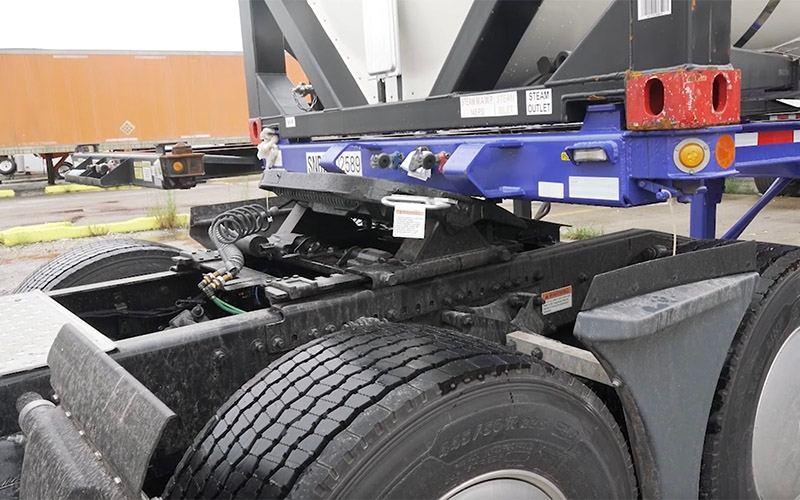
Coupling and uncoupling a trailer is among the most important skills that a truck driver should master. Despite the fact that it might look like the same thing all the time, mistakes in trailer coupling or trailer uncoupling are the largest contributors to the equipment damages, injuries, and costly downtime. The proper way to connect tractor and trailer is not only through skill but also through observing safety measures, doing vehicle inspection, and disciplined equipment use.Understanding how to couple and uncouple a trailer correctly is a foundational skill that directly affects driver safety, equipment reliability, and daily operational stability.
This guide is a step-by-step manual on how to couple the trailer using safe means and uncouple it, with a focus on trailer stability, fifth wheel alignment, air brake systems, and operating procedures. You may either be a newcomer to truck driving or refreshing the driver course; but in both cases, learning the fundamentals is the basis for the safety of the driver in the long run and the proper functioning of the equipment.
The Construction of the Tractor-Trailer Connection
Before you go about connecting or disconnecting the trailer, it is crucial to first learn how the whole tractor-trailer system works as a unit.
The connection comprises of:
- The fifth wheel gripping the trailer kingpin
- The air brake system that provides service and emergency air
- Electrical connectors that power the lights and ABS
- Proper load distribution to achieve booster balance and control
A failure in any of these can lead to altered trailer handling, braking performance, and overall vehicle maneuvering. Hence, trailer coupling can never merely be a mechanical job but also an operation that involves safety issues.
Tractor–Trailer Connection Components
| Component | Function | Safety Impact |
| Fifth wheel & kingpin | Locks tractor to trailer | Prevents trailer detachment |
| Air brake system | Supplies braking pressure | Ensures controlled stopping |
| Electrical connectors | Power lights and ABS | Maintains visibility & compliance |
| Landing gear | Supports trailer when uncoupled | Prevents trailer collapse |
| Load distribution | Balances axle weight | Improves stability & handling |
Proceeding with Safety Pre-Coupling Rite
Before drawing under the trailer, perform basic trailer safety checks and vehicle inspection steps.
Key items that must be verified:
- The height of the trailer is correct for the fifth wheel
- The landing gear operation is stable and fully functional
- There are no visible damages on the kingpin or apron plate
- The fifth wheel jaws are open and have been adequately greased
- The area surrounding the trailer is clear of obstacles
The most common coupling error is skipping these checks, mostly due to time pressure.
Pre-Coupling Safety Checklist
| Inspection Item | What to Verify | Risk if Skipped |
| Trailer height | Matches fifth wheel | Improper lock |
| Landing gear | Fully functional | Trailer drop |
| Kingpin/apron | No damage | Lock failure |
| Fifth wheel jaws | Open & greased | False coupling |
| Surroundings | Clear | Collision/injury |
Correct Coupling Techniques: A Detailed Process
Knowing how to couple and uncouple a trailer step by step helps drivers avoid common mistakes that often occur during routine yard or dock operations.
1. Position the Tractor with the Trailer
Correct fifth wheel alignment is vital. The tractor should be parallel and level without side loading of the kingpin with the trailer.
Good alignment will enhance:
- Locking engagement
- Trailer stability
- Less wear on equipment
2. Back Gradually and in Control
Employ gentle vehicle maneuvering and set the vehicle speed low. Look out for the audible “click” that the fifth wheel makes when it locks around the kingpin.
3. Execute the Tug Test
After coupling:
- Apply trailer brakes
- Gently pull forward
This is to ensure the hitching is secure and the trailer does not accidentally detach.
4. Connect Air and Electrical Systems
Attach:
- Service and emergency air lines
- Electrical connectors
Recognize leaks and confirm that the air brake system builds pressure correctly.
5. Raise the Landing Gear
Carry out a proper landing gear procedure by raising it completely before moving, thus ensuring full clearance.
Inspection on the Trailer After Coupling
Never by-pass a post-coupling trailer inspection.
Verify:
- Fifth wheel jaws fully closed
- There is no gap between the fifth wheel trailer and the apron
- Air brake system is functioning properly
- All the lights, signals, and ABS are functional
These are all part of standard safety protocols and driver education standards.
Post-Coupling Inspection Table
| Area | Verification | Safety Result |
| Fifth wheel | Fully locked | Secure connection |
| Apron contact | No gap | Prevents drop |
| Air brakes | Pressure OK | Reliable braking |
| Lights & ABS | Operational | Legal & visible |
How to Couple and Uncouple a Tractor Trailer | Step By Step Guide
Proper Procedures of Uncoupling
Uncoupling also requires the same seriousness that coupling does and is therefore committed.
1. Secure the Trailer
- Park on a level and strong ground
- Set the trailer brakes
- Chock wheels where needed
The detachment of the trailer takes place in a stable manner, which is an important factor.
2. Lower the Landing Gear
The landing gear should be grounded before any air or electrical lines are disconnected.
3. Disconnect Air and Electrical Lines
Protect the lines to avoid damage or contamination.
4. Release the Fifth Wheel
Ensure you use the proper unloading technique for your type of machine. Do not ever force the release.
5. Pull Out Gradually
Utilizing the capable and controlled vehicle maneuvering may save your time and avoid equipment damage by not allowing the trailer to move.
Safe Uncoupling Sequence
| Step | Action | Purpose |
| Secure trailer | Brakes & level ground | Prevent movement |
| Lower landing gear | Full support | Avoid collapse |
| Disconnect lines | Secure lines | Prevent damage |
| Release fifth wheel | Correct method | Protect mechanism |
| Pull out | Slow & straight | Maintain stability |
Main Coupling and Uncoupling Errors
Even quite experienced drivers make mistakes when safety measures are hurried through.
Some common issues are the following:
- Wrong fifth wheel alignment
- Forgetting to perform the tug test
- Connection of the air brake system being incomplete
- Raising landing gear before locking it up correctly
- Uncoupling on an uneven surface
Common Errors and Consequences
| Error | Consequence |
| Misalignment | Incomplete lock |
| Skipped tug test | Trailer separation |
| Air line failure | Brake loss |
| Early landing gear raise | Trailer drop |
| Uneven surface | Instability |
Emergency Procedures & Equipment Handling
If anything feels wrong during coupling or uncoupling:
- Stop immediately
- Re-inspect the connection
- Do not attempt to fix it while moving
The reasons behind the Emergency Procedures are to avoid injuries and equipment failure. Always safe equipment usage over speed.
Advanced Safety Guidelines for Tractor-Trailer Connection and Trailer Hitching
The tractor-trailer connection and trailer hitching procedures are highly secured due not only to the coupling of coupling tractor-trailer trailers initially correct but also to the proper adherence to the safety guidelines laid down. Repetitive tasks are trailer hitching, but modern complacency is one of the main distracting factors which may happen even when very experienced drivers coupling mistakes do. Each junction of the tractor-trailer should, instead of a commonly practiced shortcut, be perceptibly treated as a safety-critical moment.
In the process of trailer hitching, the factor that is most often neglected is the condition and processing of electrical connectors. A broken connection and improper line can cause the light to fail, ABS debug to appear and operating without compliance to the law, all of which have a direct consequence on the driver’s safety. Before relocating, drivers should visually confirm whether the electrical connectors are securely seated, unobstructed by corrosion, and safely secured so that they will not drag or put the trailer in tension during the turn.
Driver training is at the heart of the successful reduction in coupling mistakes. Training programs that are structured adequately not only address mechanical steps but all so the decision-making aspects under pressure. Realizing the importance of each step of the process therefore rather than reciting a rule book by heart enhances equipment handling and makes them less exposed to dangers in actual field operations.
Another thing to keep in mind while establishing a safe tractor-trailer connection is the trailer’s state of repair. A faulty 5th wheel mechanism, a broken kingpin, or a neglected landing gear increase the risk of connecting the trailer wrongly or the trailer falling off unexpectedly. Ongoing checks and preemptive care are the means through which the coupling mechanisms are kept in their original working state.
Clear safety guidelines additionally oblige drivers to reassess the connection after short moves within the yards or terminals. Moving the trailer should always follow visual inspection and brake test, even if it seems that the move is minor. This discipline protects both the driver and surrounding personnel.
In operating trucking companies, proper tractor-trailer connection is not a single event but a targeted continuous safety process integration of training, equipment condition, and disciplined execution.
Uncoupling Procedures, Emergency Response, and Long-Term Driver Safety
Correct uncoupling procedures are just as critical as coupling itself, yet they are often the ones that are frequently overlooked. Trailer detachment is associated with particular risks that include the trailer’s state of balance, the surface’s capability, and load balance. Not adhering to the laid down uncoupling procedures in the first place can lead to a shift in the balance of the trailer, equipment destruction, or permanent injury.
Before the initiation of the trailer detachment, the drivers should thoroughly check that the trailer is resting on a sturdy and level ground. The landing gear should be fully deployed and should have the capability of supporting the trailer’s weight as need be. Rushing this crucial step is a frequent cause of trailer unbalance particularly when the loads are uneven or the ground surface is shifting.
The separation process mainly involves the consideration of a situation called emergency procedures. If there is a difference in the force that is needed to free the fifth wheel, the operation should be suspended right away. Optical components should not be forced as these can damage the clocking mechanism and create unacceptable conditions. Most of the time, the problems can be easily solved by rechecking the air pressure, trailer brakes, and alignment.
Uncoupling is done in a manner that involves the use of and management of air lines and electrical connectors. All lines should be secured as they can cause contamination, impact damage, or premature wear. This small step would further contribute to the task of trailer maintenance in the long run, thus negating coupling problems in future.
Driver safety is reliant on the degree of consistency that is attained. Proper uncoupling procedures not only ensure drivers’ safety but also protect other people working in the yard, docks, and terminals. In the training programs for drivers their instructors bring it to the attention of the trainees that emergency procedures should not be viewed as signs of failure, but rather as elements of a true professional who is aware of the situation.
Over time, the strict enforcement of the trailer detaching practices will lead to a reduction of the injury risk, equipment longevity, and will reinforce a safety-first mindset. In the case of modern trucking operations, uncoupling propulsion is not an optional process, but rather a core competency which is directly linked to operator safety and reliability in operation.
The Importance of Right Coupling in Sustainability
Learning how to couple and uncouple a trailer is not just about passing training, but about developing consistent habits that protect both the driver and the equipment over time.
Regular and right trailer operation is the basis for:
- Driver security
- Trailer care
- Reduced breaks
- Better equipment maintenance record
Proper coupling skills are not only for training completion but are also for inculcating a professional habit that will eventually protect both the driver and the equipment.
In Summary
Safety in coupling and decoupling a trailer is a primary skill in truck driving. Adhering to proper coupling techniques, safety protocols, and consistent trailer inspection allows the drivers to lower risks and increase operational reliability.
You may be new to the sector or you may find it conducive to reiterate the right practices, disciplined trailer handling and correct uncoupling techniques remain essential elements of professional and safety-focused driving.
FAQ: Safety in the Coupling and Uncoupling of Trailer
What is the most common mistake made when coupling trailers?
The most common mistake is the improper fifth wheel engagement due to erroneous coupling by misalignment or skipping the tug test. This may lead to a situation of partial locking that increases the possibility of the trailer coming off completely while moving for the first time.
Why is the fifth wheel alignment so essential when coupling a trailer?
The right fifth wheel alignment makes it possible for the kingpin to enter the jaw locks in the correct manner. If there is a misalignment, it can prevent the clamping jaws from fully engaged and thus negatively impact trailer stability coupled with the rapid wear on the coupling components.
When should the emergency procedures be executed during the coupling or uncoupling process?
In association with emergency procedures, such measures should be put in place without delay if there is any resistance, unusual movements, or unexpected forces that are felt. This is to imply that the stopping and rechecking on the tractor-trailer connection are very important along with making the necessary corrections before the moving action in order to successively avert injury and equipment damage.
What is the need of inspecting a trailer after short yard moves?
Yes. A short repositioning move also requires a visual inspection and brake check. Minimal movements may put extra stress on the coupling system, air lines, or electrical connectors, hence, the post-move inspection becomes a key safety issue.
In what way does the right uncoupling bring an improvement to the long-term driver safety?
Following the same uncoupling procedures consistently cuts down the chances of a trailer falling, lines getting ruined, and sudden shifts of the trailer. In the long turn, the proper uncoupling practice contributes to the development of safer yards, better equipment handling discipline, and these result in lower injury exposure to the drivers.