
Automation discussions have become essential to the trucking industry
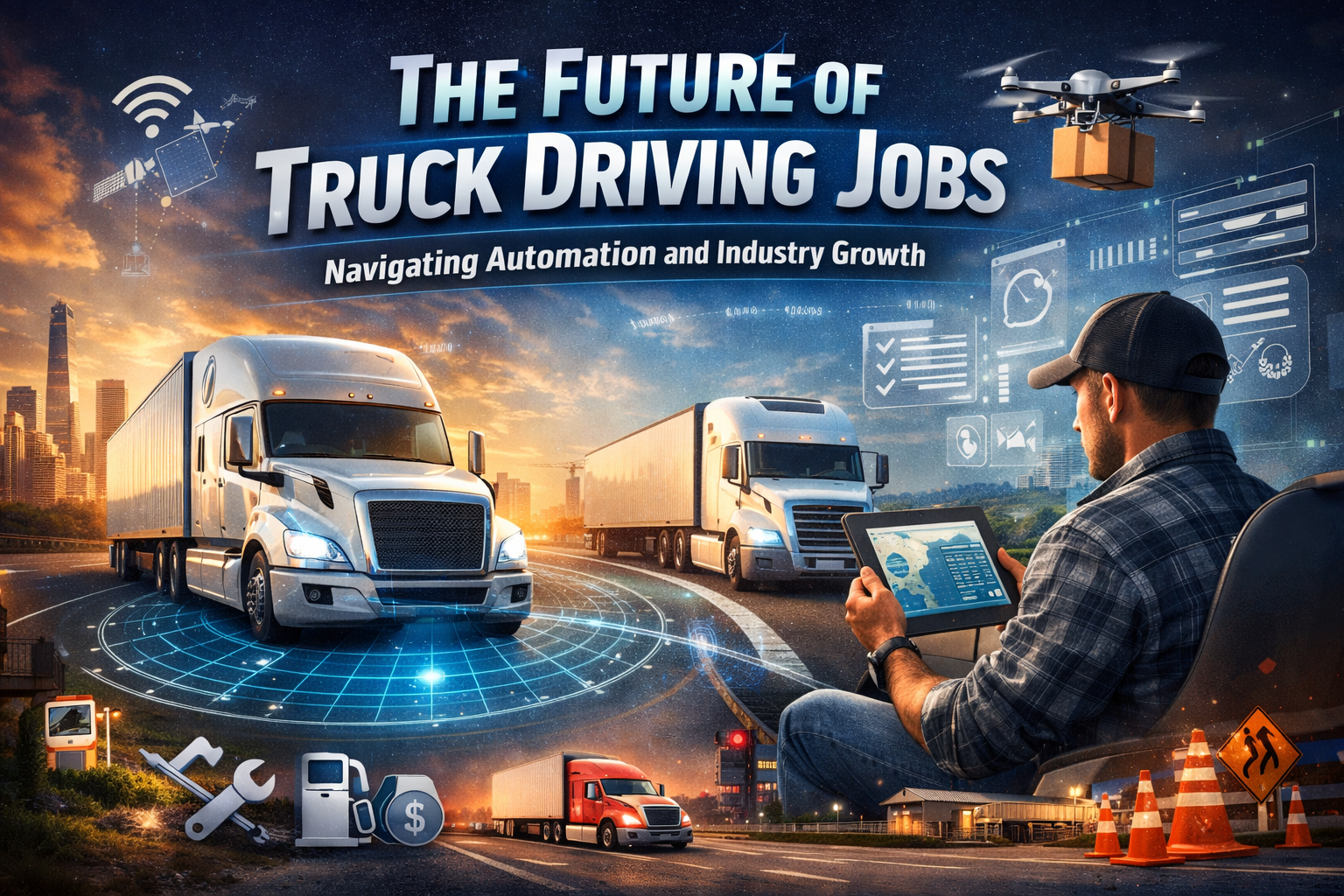
Automation discussions have become essential to the trucking industry. Autonomous trucks, self-driving vehicles, and freight automation are casually introduced as technologies that will exactly displace drivers honestly. The fact is, the reality stands to be much more complicated. Truck driving jobs in the future will not entirely vanish; instead, that shift is due to technological progress, government regulations, and industry development.The future of truck driving jobs is shaped less by full automation and more by how technology, regulation, and industry growth redefine the driver’s role.
The Quiet Race to Build Self-Driving Trucks in the US and Europe
According to the advancements in driverless vehicles, Real-world mail is still very much dependent on a person making the decision. Weather changes, traffic jams, loading issues, customer relations, and rules and regulations are not automatable completely yet. Therefore, the entry of automation in the trucking sector is not as a replacement but as a help-side instead.
A report on trends in trucking employment designs driver tears based on a study that shows fleets are utilizing driver safety technology, automation of logistics and software to mitigate fatigue, enhance routes, and boost adherence. These systems help drivers rather than taking them out of the picture. The effect of automation on truck drivers is that it is changing their work styles but it does not affect the demand for them.
The Limitations of Driverless Trucks & Driverless Freight
Although autonomous freight trucking always makes news, its application has remained somewhat limited. Most self-driving trucks’ tests are exceptional to particular highway corridors, good weather, and ordered operations. Automated vehicles on line-haul first, but the driver’s supervision is still a must.
Risky situations such as construction, mitigation emergencies, traffic disruption, and last-mile pickup delivery that need human intervention. Thus, instead of competing against automation, the training system of drivers ships them to work with automation.
By no means are autonomous trucks likely to end jobs. More likely, they will alter the job description. Truck drivers may assume positions watching the vehicle, safety checkups, and liaising with the logistics system. In this new environment, the survival of truck driving jobs depends more on adaptability than on a technological backoff.
Truck Driver Shortage and Industry Growth Pressures
The trucking industry is still suffering from a chronic truck driver shortage, despite the automation breakthroughs. Requirement for drivers at the freight, e-commerce, and distribution channels has seen an upswing forced largely by shifts in the current market.
The growth in trucking has long outstripped the recruiting pipeline. Retirements, difficult lifestyle matters, and the lack of available CDL training slots have all contributed to the issue. Automation as a solution to this issue has not been effective. In fact, in some instances, it has underlined the importance of human drivers more than machine-driven systems.
There is a strong demand for trucking jobs, especially those that involve regional hauling, dedicated routes, and dry van truck driving jobs where consistency and flexibility are essential. Employed in such segments these jobs are at lower risks of being automated and still they form the backbone of freight movement.
The Impact of Automation on Driver’s Daily Responsibilities
The advent of automation in the trucking industry is already affecting how drivers do their daily tasks. The responsibility of being a truck driver in some cases does not end; it shifts to a big extent from operating the vehicle to become a coordinator of the operational system.In this context, the future of truck driving jobs depends on drivers evolving into system-aware professionals rather than being replaced by automated vehicles.
Will automated vehicles replace truck drivers?
Shifts in key responsibilities are:
- Observing automated driving assistance systems
- Decoding safety alerts and override scenarios
- Ensuring compliance by means of digital platforms
- Collaborating with dispatch via integrated logistics tools
- Deeming when automation cannot be used
Driver Role Evolution Comparison
| Area of Work | Traditional Role | Automation-Influenced Role |
| Vehicle control | Manual driving | Assisted supervision |
| Route planning | Dispatcher-based | Algorithm-supported |
| Safety monitoring | Visual awareness | Tech + human judgment |
| Compliance | Manual logs | Digital systems |
| Problem solving | Reactive | Proactive |
This reassures that instead of displacement, automation actually increases driver responsibility.
CDL Training and Workforce Development in an Automated Era
With the evolution of technology, CDL programs are being modified too. Currently truck driving programs will introduce the students to the relevant driver safety technology, automated driver aid systems, and digital compliance. The program aims to prepare drivers to operate in environments where automation supports rather than replaces them in their daily tasks.
Trucking workforce development is becoming a strategic priority as fleets invest in long-term driver training, technology adaptation, and career sustainability rather than short-term labor fixes.
Workforce development efforts are continuously focusing on initiating long-term career sustainability. Training goes beyond teaching vehicle control as it now includes system awareness, safety analytics, and operational decision-making. These subjects are aimed at building driver confidence and hence eliminating the fear which fleet operators have about automation and safety.
This shift leads to drivers’ job security as they become the skilled operators working with cutting-edge transportation systems. Thus, those who are dedicated to the technological emphasis and continuous education will have the best chances in the drive industry.
Human-Centric Automation and Safety Technology
Driver safety tech is one of the most dominant aspects of automation in the truck segment. Collision avoidance, lane-departure warnings, adaptive cruise control, and fatigue monitoring are these tools becoming a standard in fleet management. These tools help in risk mitigation while retaining the driver’s authority.
Safety automation should not be seen as competing against the driver but as an additional way of lifeguarding. The insurance data and operational studies determined that the drivers secured by the devices performed better than autonomous vehicles in uncertain environments.
The challenges of the transportation sector such as liability, regulatory complexity, and the general public trust further reinforce the call for human involvement. Automation not only improves the safety outcome but also the drivers’ accountability and decision-making gift the work to experienced professionals.
Automation Impact by Freight Segment
Not every segment in trucking will see the same effects from automation. Different segments have different exposure depending on route structure, operational complexity, and customer interaction.
Automation Exposure Across Freight Types
| Freight Segment | Automation Exposure | Reason |
| Long-haul highway | Medium | Predictable conditions |
| Regional freight | Low | Mixed environments |
| Urban delivery | Very low | High complexity |
| Dedicated routes | Low | Operational consistency |
| Specialized freight | Minimal | Human expertise required |
Thus the employment situation is stable in many segments of freight.
Employment Trends and Long-Term Outlook
Current trucking employment trends suggest gradual evolution, not disruption. Robotics in logistics is streamlining functions in the background even if the drivers will be still very important on the roads. The future of the industry points in the direction of a stable demand for skilled drivers, particularly those who are ready to cooperate with technology.Overall, the future of truck driving jobs points toward stable demand for skilled drivers who can operate alongside technology in an increasingly complex freight environment.
Career options have expanded not only to the freight hub, but regional processes and tech-aided driving roles. Drivers who keep up a continuity with learning and flexibility will be the ones who survive and promote.
Automation will keep on reshaping tasks, but it will not put the science of trucking on the decrease. On the contrary, the profession will be regenerated with new expectations, responsibilities, and the opportunities of the drivers.
Trucking Industry Expansion and Job Opportunities in a Dynamic Environment
Notwithstanding apprehensions concerning automation, trucking industry growth is one of the most consistent patterns in the transportation sector. Freight shipments are still growing due to the increase in e-commerce, the manufacturing reshoring and the demand for flexible supply chains. All these factors support the long-term need for truck drivers directly.
Instead of contraction, trucking career opportunities are going to be more diversified. Nowadays, drivers are not merely bound to long-haul ranks. The quick growth of regional operations, dedicated freight, intermodal coordination, and technology-supported driving positions is not surprising. These roles typically involve good conditions such as a predictable schedule, steady freight, and less automation risks.
Furthermore, the rapid growth of the industry leads to the increase in wages, benefits, and improved working conditions. As the competition of fleets for the skilled labor force escalates, Drivers who are willing to adapt to new systems are given the benefits of having more choices on the jobs and potential for salaries. It is due to this scenario that trucking stands out as one of the sizeable few industrial fields where technical progress matches demand instead of contraction.
Logistics Automation as a Support System, Not a Replacement
Most of the discussion about automation concerns vehicles, but logistics automation works mostly behind the scenes. Dispatch optimization, digital load matching, automated billing, and predictive maintenance tools make better the workflows without taking the driver out of the equation.
These systems get rid of past inefficiencies that normally burdened drivers such as poor route planning, manual paperwork, delayed communication, and compliance errors. Automation in logistics is about improving coordination instead of controlling it; thus, drivers can concentrate their efforts on execution, safety, and judgment.
Under the circumstances, autonomous freight hauling truly depends on human hands. Even in such situations when automation comes in, the drivers are system supervisors, escalation managers, and safety decision-makers. This operational model confirms the driver’s role as the ultimate decision-maker in the freight movement.
Truck Driving Training Schemes and Staff Development
The modern truck driver training programs show the shift of the industry toward being technology-driven. The CDL training curriculum is changing fast; the new drivers must have experience with driving-assistant technologies, electronic logs, safety analytics, and digital dispatch platforms.
Moreover, training for the trucking workforce is not only about getting a license but also about obtaining long-term jobs. Fleets promote constant training, mentoring, and system familiarity in order to keep drivers and also mitigate operational risk. The approach increases the driver’s confidence and minimizes the problems that arise between human decision-making and automated systems.
The focus of training today is on adaptability, situational awareness, and system interaction. Capable drivers who can understand both mechanical and electronic aspects of their job will become better competitors and will have a better chance of stability and resilience as the industry progresses.
Transportation Industry Challenges That Reinforce the Human Role
Automation does not erase the core problems of the transportation industry. For instance, liability management, regulatory compliance, unpredictable road conditions, customer accountability, and public safety expectations all proceed with the human factor in the judgment call.
Regulations refer to the driver’s presence again and again because of accountability and safety concerns which give a strong impression that drivers are the mandated regulators. The insurance frameworks, legal responsibility, and public trust continue to be with the human operators. Due to these realities, full automation will not be possible and it is along this line that the demand for well-trained drivers is sustained.
Instead of eliminating, technology gives more importance if the workforce is composed of experienced professionals who can analyze data, override systems when necessary, and react adequately in situations that are not normal.
Conclusion: Adapting Without Disappearing
Automation is leading to changes in the trucking industry — though not in the ways headlines typically suggest. The autonomous trucks and driverless vehicles although moving forward are still subject to clear limits. Freight transport, as well as safety, and operational reliability are still centered in human drivers.
The sector’s prospect is for the people who will see that automation is a vehicle and not a weapon. The drivers who will adjust to training and new technologies will discover that the trucking offers a well-decorated, flourishing, and indispensable employment for years to come.
Some popular FQs
Will AI trucks remove the need for truck drivers?
Not at this moment,. Autonomously operated resin systems are to a considerable extent depending on the control of a human operator.
Which trucking occupations government places least influenced by automation?
It is the regional, dedicated, urban delivery, and dry van truck-driving jobs that show automated problems at the lowest level.
Is the CDL still relevant in light of automation?
Absolutely, as the program is now updated and goes beyond the simple regulatory and driver training regulations.
Will automation affect drivers’ pay rate opportunities?
No, automation may improve company efficiency but will not eliminate the demand for experienced drivers.
Should drivers be worried about a truck driven by itself?
No, as it is more profitable to them to learn self-driving features than to oppose the automation.