
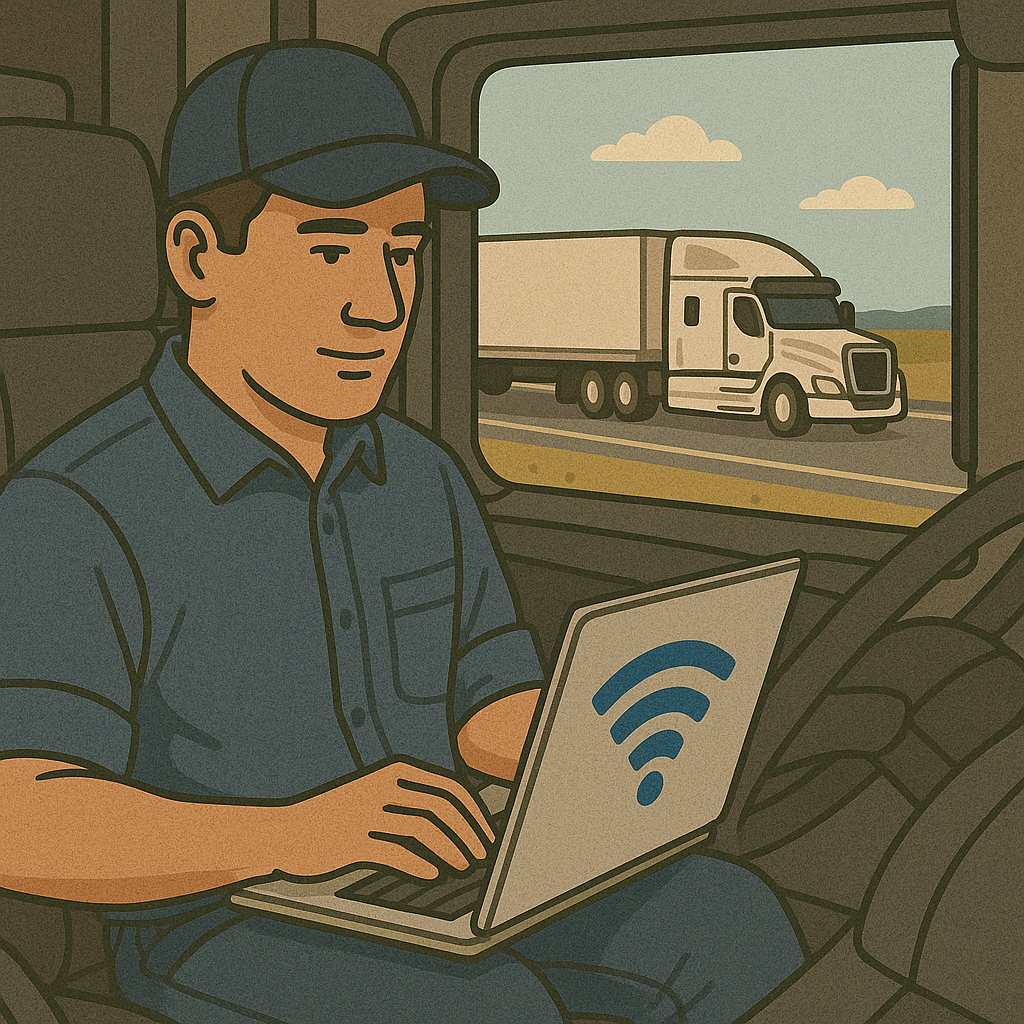
The most essential best wifi for truckers is not a luxury anymore; it has become a necessity to a huge extent. WiFi for trucks is not just about work, but it also has an indirect impact on health, safety, and general life quality. Modern truckers depend on their stable internet on the road for dispatch communication, ELD compliance, navigation updates, document uploads, and even basic personal needs like chatting with family. It was once just an issue of stability but truck stop Wi-Fi has evolved since then into a cluster of mobile internet solutions designed specifically for the trucking industry.
The road’s life is all about being connected, and it is not different for a truck but instead of a truck it is a truck that moves with the driver. Drivers of trucks travel throughout cities, states, and deserted highways where home internet services are unavailable. Wireless internet and mobile internet services, then, are the primary truck driver communication tools. Like a truck driver running regular routes or long-haul routes, having reliable WiFi directly influences his or her outputs, stress level, and shortened time off.
Limitations of Truck Stop WiFi
Truck stop WiFi, which was the first default option, is hardly the optimal choice for truckers anymore. Crowded networks, slow data speeds, high latency, and lack of coverage make them a doubtful option for anything but the most basic web browsing. Sticking on a watch list, such as streaming or gaming, or being on a video call are often seen as cloud-based dispatch systems that don’t function properly. The more technology progresses in trucking, the higher the expectations for road connectivity are.
Common issues with truck stop WiFi
- Crowded networks
- Slow data speeds
- High latency
- Lack of coverage
Mobile Internet Solutions for Truck Drivers
The majority of truckers making use of mobile internet solutions are rooted in 4G LTE and 5G networks nowadays. They are devices that use cell infrastructure to transfer internet access anywhere it is within range. In the truck cabs, mobile hotspots, dedicated routers, and mobile hotspot devices have all the time become important items. Demand for hardware quality, carrier collaborations, and data policies is an essential differentiator between reliable connections and frustrating ones.
Tags that are such commonly used modes of access to the internet on the truck include mobile hotspots. They are gadgets that locate themselves via cellular networks and bectlare Atlassian Stash a signal WiFi for other devices inside the truck. That is, several devices like the phone, tablet, ELD unit, and laptop, with only a single shared connection to the WiFi network. Pondering upon the subject Compatibility, truckers often deal with a plethora of issues such as sharing their WiFi network among the devices they use for work and entertainment.
Data Plans and Provider Options
Data plans also play a very important role. Most common consumer plans, in contrast, are restricted and thus throttled after certain limits, so they are not fit for full-time trucker internet use. This is where specific providers such as mentioned earlier in this part of the article like SwiftNet, EpicWiFi, Horizon Powered, Unlimitedville, and UbiFi unveil themselves. They are firms specializing in mobile internet offering well-cut plans primarily aimed for heavy traffic and displacement.
SwiftNet appeals to truckers with its focus on simplicity and steady performance. It is a vendor of plug-and-play types of assembly being simple and which require no technical support. EpicWiFi and Horizon Powered suit drivers who have broader WiFi coverage and contract flexibility as their main concern. Unlimitedville and UbiFi are visionaries for truckers who look for a higher data allowance and better coverage in rural areas through multi-carrier connections.
Mobile internet providers mentioned
- SwiftNet
- EpicWiFi
- Horizon Powered
- Unlimitedville
- UbiFi
4G LTE vs 5G Connectivity
The shift from 4G LTE to 5G mobile internet speeds has led to a noticeable performance increase in many regions. Why? Because 5G is significantly faster and offers lower latency, making it easier to stream content, play online games, join video calls, and browse the internet in real time.
For drivers looking for the best wifi for truckers, this speed advantage can be a major benefit — especially during long stops or overnight breaks. However, coverage still varies by location. Many rural highways and remote trucking routes continue to rely primarily on 4G LTE, and in some areas, both networks overlap.
For this reason, devices that support both 4G LTE and 5G are often the most practical choice for truckers who need stable connectivity across changing coverage zones.
Satellite Internet Considerations
Satellite internet occasionally arises in the analysis of problems on the trucker but it is a rare one. Due to its limit on the area and network, it outperforms satellite internet in very remote areas. But unlike satellite internet, it is also more care-free, and cost-effective, though it’s user-friendliness is quite similar. In most cases, truckers find that cellular-based WiFi solutions work well and with less hassle in terms of costs, performance, and usability.
Comparison of WiFi Solutions for Truckers
Comparison of common WiFi solutions for truckers
| Solution type | Coverage | Data speeds | Latency | Best use case |
| Truck stop WiFi | Limited | Low | High | Short stops only |
| Mobile hotspot (4G/5G) | Wide | Medium–High | Low | Daily use |
| Dedicated mobile router | Wide | High | Low | Multi-device setups |
| Satellite internet | Global | Medium | High | Remote areas |
Hardware Performance and Device Choice
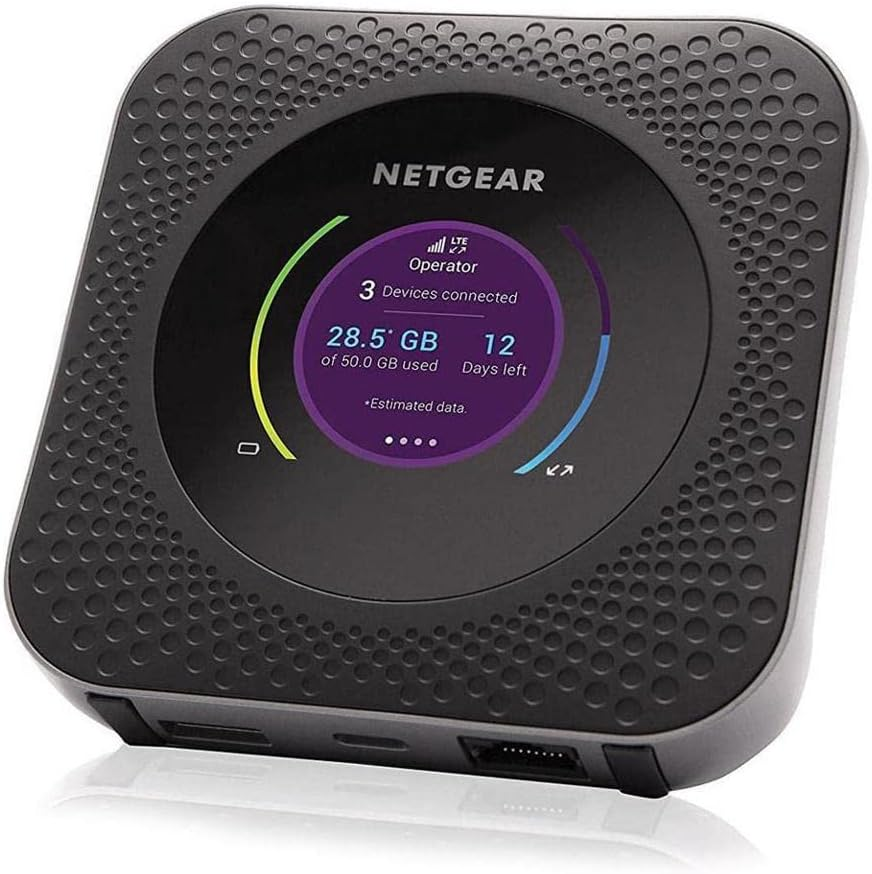
Device type has a direct bearing on performance. Dedicated mobile routers usually outspeed simple hotspot devices that are made of external antennas and handle stronger signal processing. One popular and good choice that the truckers have is a mobile hotspot/router that is NETGEAR Nighthawk M1; this device has several bands of support and strong device compatibility. You can see the device here: https://www.amazon.com/dp/B07G5KWZ3H
This device allows truck drivers to stay in touch with the internet freely even in areas where the signal is not very strong, especially when it is used together with external antennas.
Nighthawk M1 Mobile Hotspot Router Review! Unlimited 4G LTE Data No Throttling
Cost, Contracts, and Flexibility
However, the cost factor, as well as the terms of the contract, are equally important. Long-term contracts that lock in drivers and limit their flexibility should be avoided, especially ones that are connected to a single carrier with poor diversified rural coverage. Month-to-month plans or flexible contracts allow drivers to adapt as routes and needs change. The best internet solutions balance affordability with reliability rather than chasing maximum advertised speeds.
WiFi and Trucker Lifestyle
Connectivity is not exclusive to work anymore. The lifestyle of a truck driver now heavily contains online job tasks, streaming services, and gaming, among other social functions. Thus, good WiFi for truckers is a mental health-promoting tool that keeps them grounded and solves the problem of boredom during downtime. A trucker can build emotional balance by watching a movie, attending a video call, or playing an online game after a long shift.
Navigation and dispatch systems also depend heavily on stable mobile internet. Real-time traffic updates, weather alerts, route optimization, and communication with dispatch reduce delays and safety risks. ELD compliance requires consistent data transfer, making reliable Internet a compliance issue rather than a convenience.
Activities supported by trucker WiFi
- Dispatch communication
- ELD compliance
- Navigation and weather
- Streaming and entertainment
- Gaming and social connection
- Remote work tasks
Internet-Dependent Trucker Activities
Trucker activities that depend on reliable internet
| Activity | Internet importance |
| Dispatch communication | Critical |
| ELD compliance | Mandatory |
| Navigation and weather | High |
| Streaming and entertainment | Medium |
| Gaming and social connection | Medium |
| Remote work tasks | High |
Coverage, Latency, and Practical Selection
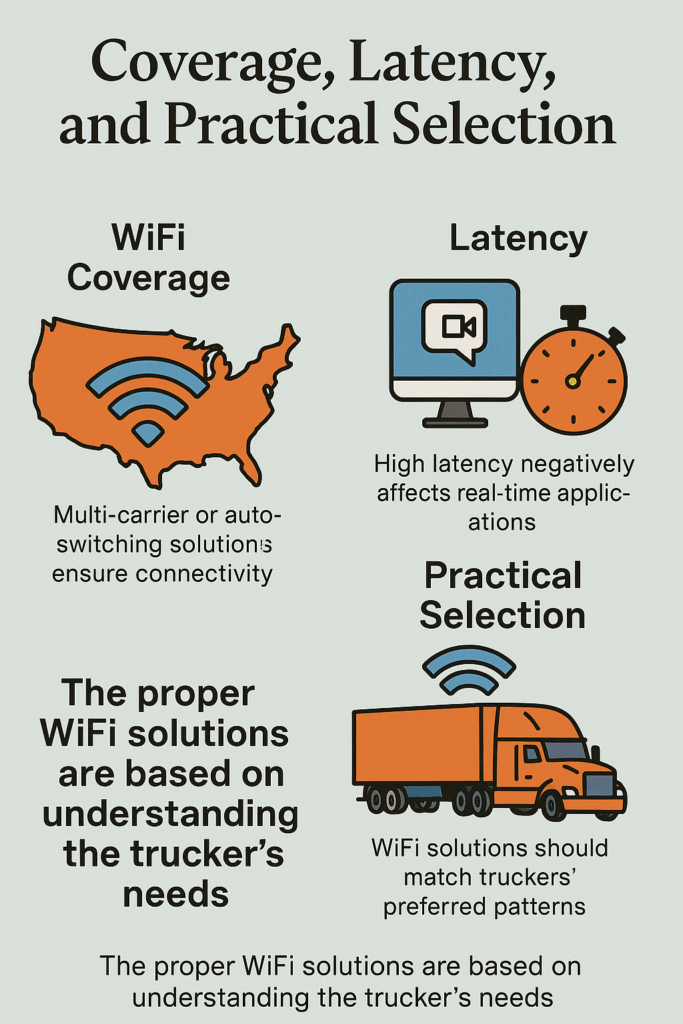
WiFi coverage still is the most significant factor for practically all truckers. Given that there is no single provider that can achieve all-around coverage, many drivers see the merit of using multi-carrier or auto-switching solutions. This ensures that even if one signal weakens, there is always another that can take over the control and maintain the connectivity.
Latency equally remains an overlooked point. High data speeds notwithstanding, if high latency otherwise affects video calls and applications, the overall functionality of the system suffers. Based on the fastest possible speed, mobile internet is generally lower than satellite options, making it more suitable for real-time communication and navigation.
In the end, the proper WiFi solutions for truckers are based on understanding the truckers’ preferring patterns. For example, a driver who needs a dispatch access especially to upload ELD may not need the same configuration required by one who streamsHD video or works remotely from the truck. Pinpointing truckers’ internet solutions matching their needs is a way of not wasting money and avoiding disappointment.
This is also where remote work becomes a deciding factor for some drivers, while others focus purely on dispatch and compliance. The best mobile internet options are the ones that match real trucker needs on the road, not the marketing promises on paper.
The Role of Connectivity in Modern Trucking
Internet access being a part of professional competence has been the result of the trucking industry becoming more and more connected. The quote on trucker connectivity being a must-have like knowing routes or managing hours of service is probably true. The drivers who choose to install reliable mobile internet connections are the ones who make significant progress, thus they receive the benefit of a better experience on the road.
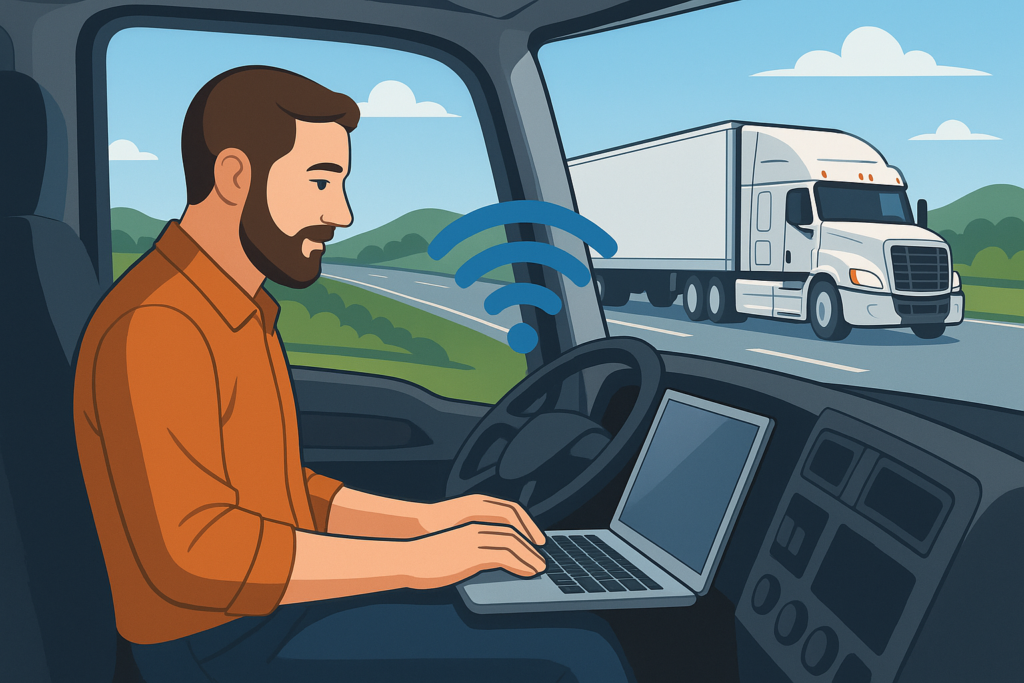
Best wifi for truckers is not defined only by brand names; it is the only one quad included in the range of constant coverage, reasonable data policies, manageable costs, and hardware that is a must to support the reality of life on the road. The setting can be so cool that the internet on the road is a reliable and practical tool, not a daily struggle.
For modern truckers to be more connected, they have to be competitive, they need to stay compliant and find ways to keep their minds balanced. Reliable WiFi is there for them to support their work, lifestyle, and wellness. In this world of mobility, it is the connectivity that keeps everything moving along.
What truckers ask in real life
1. For what reason is wireless internet the necessity of modern truck drivers?
Wireless internet is a way of drivers to be in touch with others in the course of their hitching from one place to another whether it is related to local, state or even rough terrains. It is a must-have for the navigation that relies on the internet, compliance and communication, and personal needs digitizing trucking sector instead of just being a convenience.
2. Explain why truck stop WiFi might not be the best option for daily use?
Truck stop WiFi, which is available in trucking hotels most of the time, can be unstable with high congestion, low speeds, and intermittent connections. Though it can work for short stops, it rarely meets the drivers’ professional logbook standards of reliability and of continuous online access.
3. Explain the impact of contract terms on the selection of an internet provider when on the road?
The issue is that trucking routes and workloads get shifted frequently. Flexible agreements are the ideal ones because they allow drivers to adapt the arrangement and still avoid taking on long commitments that may not be suitable for their operations anymore.
4. What is the role of internet connection in the trucker lifestyle outside of work tasks?
Stable internet connection makes resting, communicating with relatives, and enjoying off-time activities a lot easier. This draws a line between mental well-being and the work-life balance that truck drivers have which in turn helps them to have a healthier truck life in spite of long periods they spend being on the road.
5. Is it feasible to work remotely from a truck cab?
For some drivers, work from home activities like filling out forms, reporting, or working on side projects becomes possible with strong internet connection. However, such flexibility depends largely on the reliability of the connection and compatibility of the devices installed in the cab.
6.Why do trucks’ connectivity solutions needs differs from each other?
Some drivers put dispatch and compliance at the top of their needs, while others give their greatest value to entertainment or communication during downtime. The awareness of truck cab requirements prevents paying for excess features that are not useful at all or are not effective enough to perform daily tasks.
7.How to get the Internet in the truck while traveling?
The most preferable option is having a cellular based connection such as mobile hot-spot or dedicated-roaming router on a nationwide network. Such arrangements are no trouble because of the extra mobility and wider coverage thus delivering good connectivity for average trips.
8. How is the trucker technology evolving in line with connectivity requirements?
As the use of digital devices increases in the trucking business, the connection also becomes a part of the algorithm for facilities, machines, and applications. Technological development in trucking has gone to the extent that they now require internet for effective and reliable operation.