
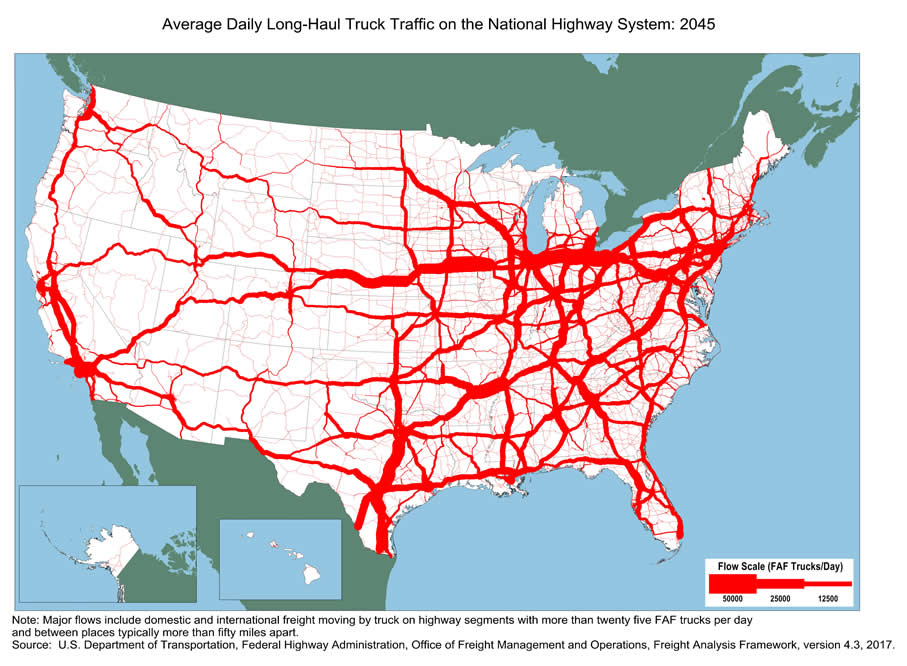
The choice of where to work as a truck driver is no longer merely a matter of weather or distance from home but differs even more due to state differences. Today, truck driver salaries, job stability, freight availability, and long-term career prospects are more dominated by state-level factors than ever. Unique environments result from the interplay of freight density, physical infrastructure, diverse industries, and state regulations.
For instance, some states are the obvious choice for good trucking jobs with high demand, stable income, and high predictability of receiving the cargo while others experience dramatic seasonal fluctuations or only carry few goods. The understanding of these factors enables the drivers to make wiser choices about their careers — be it entering the sector, changing the lane, or planning the future growth.
In this guide, you will discover the states that offer the most opportunities for truckers, based on the level of employment demand, the possibility of good pay, the freight volume available, and the situation of the trucking job market on an overall scale. These patterns help explain why certain regions consistently rank among the best states for truckers, even when national freight volumes fluctuate. For many professionals, identifying the best state for truck drivers becomes a practical question of income stability, freight consistency, and long-term work conditions.
What Makes a State Attractive for Truck Drivers
Prior to the measuring of states against one another, it is essential to understand what generates opportunity in trucking. A fair wage alone doesn’t paint the full picture of a strong market.
The factors that matter the most in the availability of trucking jobs are:
- Truck driver salaries in relation to the cost of living
- Trucking jobs and employment density
- Freight diversity (retail, manufacturing, ports, agriculture)
- The quality of infrastructure, highway access, etc.
- Trucking safety records and enforcement situations
- The conformability of trucking jobs all year round
States that have a good mix of these elements usually offer more income stability and longer careers.In real-world conditions, the best state for truck drivers is often defined not by advertised pay rates, but by steady freight flow and predictable job availability. In practice, this combination determines how many real trucking job opportunities exist beyond short-term hiring spikes.
Texas: The Largest and Most Diverse Trucking Market
Texas is one of the best trucking states in the nation and is, therefore, the natural leader in this regard. Its colossal scale, geographical center, and various sectors naturally result in an unending flow of freight.
The factors of the Texas advantage are:
- Several major distribution hubs (Dallas–Fort Worth, Houston, San Antonio)
- A solid oil, manufacturing, retail, and cross-border freight
- A high number of trucking job openings in OTR, regional, and local roles
- Transportation offers truck drivers flexible routes which they can use to make a better-than-competitive salary
Texas has always been above the national average of trucking employment rates and the strongest demand for trucking jobs in the state, especially for the experienced truck drivers.
California: High Demand, High Complexity
California not only has the largest trucking job market but also offers jobs in the transportation sector at the cost of other areas.
Assets:
- A huge port area (Los Angeles, Long Beach, Oakland)
- Availability of many trucking jobs in regional and local freight
- Likely high salaries for specialized and port-related work
Challenges:
- Participating in the strict regulatory environment
- More compliance costs
- Traffic congestion leads to reduced productivity
In spite of the ongoing pressure from legislation, California’s trucking market features excellent performance in the freight volume levels.
Florida: Growing Demand and Steady Freight Flow
Florida’s transportation sector has witnessed considerable growth owing to population increase, retail, and import-driven freight.
Strengths include:
- Continuous freight throughout the year
- High demand for regional and dedicated routes
- Increasing the trucking job outlook powered by construction and retail work
Though some regions might have a weak outbound flow of freight, the overall trucking job is still good especially for drivers who are ready to work regionally.
Illinois: The Freight Backbone of the Midwest
The very spine of freight in the country is carried by Illinois which has a key role in the national logistics system.
The reasons that make Illinois unique are:
- Chicago the central hub for rail and trucking
- A tightly-knit network of intermodal and regional freight
- High trucking employment rate and wage turnover (means more job openings)
Illinois is one of the best trucking states to work with, especially for those who prefer to drive on a regional basis in accordance with a well-defined schedule.
Pennsylvania: Manufacturing and Distribution Strength
Pennsylvania mixes manufacturing, warehousing, and Northeast corridor access.
There are perks:
- High regional freight demand
- Useable trucking job openings
- Relative balance in terms of living costs and income earned
Truck drivers tend to be able to find good distribution jobs without much regulatory pressure, so Pennsylvania is a good place to work for them in the long run.
Ohio: High Freight Density and Central Access
The central geographic location and well-developed industry in Ohio make it one of the most efficient states for the trucking business.
Highlights:
- High sales with short haul distances
- Regional driver demand of the trucking sector is quite strong
- Diverse freight mix which sustains work all year round
Ohio’s consistently good rankings in the trucking industry for job availability and network efficiency prove the effectiveness of this strategy.
Arizona: Rising Freight Corridor
Arizona has fastly developed into a logistics and distribution corridor.
The reasons why truckers consider Arizona:
- An increasing number of warehouses and retail distribution centers
- Good access to the interstate highway
- A rise in the number of jobs in the transportation sector
The speed with which Arizona gains popularity among drivers is evidenced by the shift towards regional routes with stable mileage without coastal congestion.
Comparing Trucking Job Markets by State
| Factor | Strong States | Why It Matters |
| Truck driver salaries | TX, CA, IL | Income potential |
| Job availability | TX, FL, OH | Reduced downtime |
| Freight diversity | TX, PA, IL | Stability across seasons |
| Job growth | AZ, FL | Long-term prospects |
| Infrastructure | OH, IL, TX | Efficiency & safety |
Safety Records and Quality of Work
Strong trucking safety records often translate into fewer disruptions, steadier freight flow, and more predictable working conditions for drivers.
Besides pay and freight, the safety records of the trucking industry are also important. States that maintain good infrastructure and have transparent laws create less stress and risk to drivers.
Laws that make it safer for drivers are usually:
- Fewer accident-prone roads
- More predictable compliance expectations
- Better insurance results for fleets and drivers
This directly affects the retention of drivers and the overall sustainability of the career field. Over time, these conditions shape trucking career prospects far more than short-term pay differences between states.
Trucking Safety Records and Their Influence on Job Application Opportunities
Besides salary or freight volume, the overlooked aspect of truck driver safety is the reason that few professionals do not understand that it has existed. However, truck safety records are related factors that directly and measurably affect trucking job availability, insurance costs, and long-term employment stability for drivers.
Road maintenance, rest areas, and law enforcement typically are included in the list of the main factors which will be improved by states with the best safety records. This, in turn, reduces accident rates, road downtime, and unexpected compliance risks. From the labor side, the safer operating environment leads to the attraction of more carriers, which ultimately results in more trucks across OTR, regional, and dedicated segments.
According to broader trucking industry statistics, states with lower accident rates tend to show steadier trucking job demand by state, which in turn, due to fewer disruptions and lower insurance pressure, can deliver more jobs to drivers on a more stable basis.
For drivers planning a long-term trucking career, states that focus on safety are usually the ones with slower but more sustainable growth. High-risk regions may offer short-term gains but often come with higher turnover and unstable employment.
Truck Drivers’ Industry Trends and the Long-Term Growth of Employment by State
The trucking market is now driven more by structural changes than by short-term freight cycles. Many of these shifts reflect broader trucking industry trends rather than isolated state-level decisions.
At present, data indicate that the strongest job creation is in states that are growing their populations, building new warehouses, and diversifying their freight transportation businesses. These factors ensure ongoing trucking job growth even during economic slowdowns.
One of the clearest indicators of future security is infrastructure-driven hiring. States expanding interstates, logistics parks, and distribution centers consistently generate regional and local trucking jobs.
These differences explain why trucking job market trends vary sharply from one state to another, even within the same region.
In many cases, the loudest markets aren’t always the strongest ones. States with stable trucking job markets, moderate growth, and consistent demand are more likely to support drivers throughout an entire career rather than during short boom cycles.
Final Thoughts: Choosing the Right State for Your Trucking Career
There is no single best state for every truck driver. It depends on someone’s experience in the field, the kind of route he/she prefers, lifestyle choices he/she makes as well as his/her view on regulations.
Nevertheless, states with:
- High trucking job openings
- Various different freight classes
- Robust trucking market indicators
- Long-term and healthy trucking industry forecast
consistently rank better in the long run.
Truck driving is a long-term profession, not a short-term throw of the dice. Finding a state with demand, infrastructure, and growth balanced out right is often the deciding factor rather than going for the highest salary you see advertised.Over time, drivers tend to discover that the best state for truck drivers is the one that supports consistent work across market cycles, not just short-term demand spikes.
Mini FAQ: Best Truck Driver’s States
What is the overall best state for truck drivers currently?
There isn’t a single ideal embodiment of a state for all truck drivers at all times. It is possible to find the best state with the right parameters such as frequent freight, jobs availability, good safety conditions, and longer-term government support of employment compared to short-term backing.
Does a higher truck driver salary always indicate a better job opportunity?
Not in every case. The states that offer higher wages may also have a higher cost of living, stricter regulations, or problems with freight inconsistency. Reliable full-time truck driver employment usually results from the equilibrium of the labor market rather than just high salaries.
What impact does trucking safety record have on the drivers’ employment?
Usually, having good trucking safety records will result in more freight being delivered, lower insurance premiums, and a more regular work schedule. Due to those reasons, job stability, and the potential for long-term career improvement are more often the case than not with the drivers.
Is Trucking job growth more significant than the current availability of jobs?
Both are of equal importance, however, in the long term, trucking job growth should be seen as the better indicator for career planning. The states that show sustainable growth are more likely to provide jobs through different market cycles.
Should drivers use as a base the industry’s development or current figures?
The best choice is the one that integrates both elements. The present demand leads to immediate income, while trucking industry trends uncover states that are streamlining the labor market for a longer period of time.